
“Educational reform cannot be achieved in isolation”
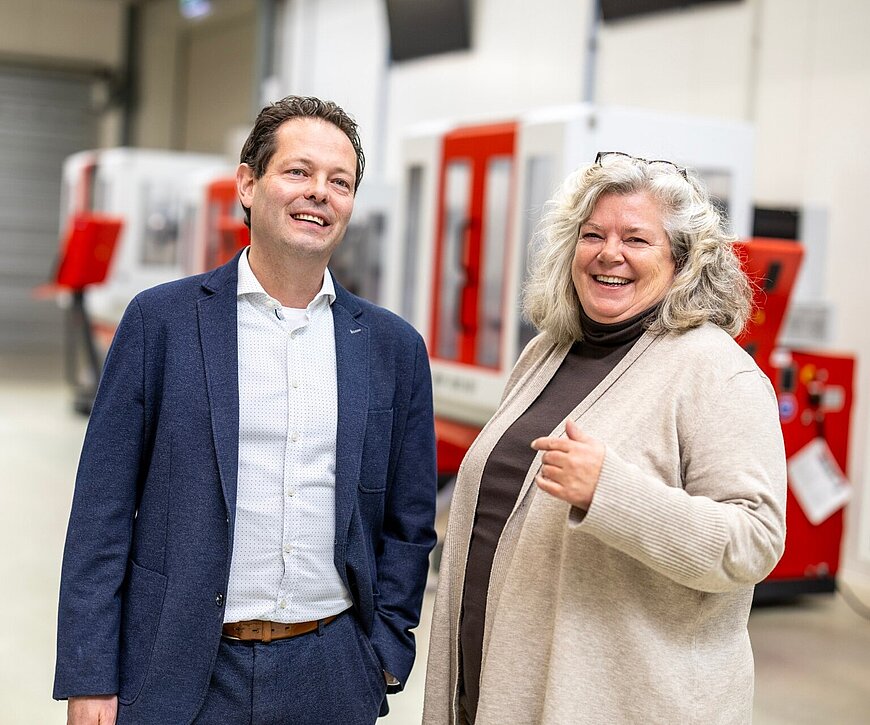

In the coming years, a great deal of talent will be needed to fill the vacancies in the semiconductor sector in Brainport. It therefore makes sense that part of the Beethoven funds is earmarked specifically for retaining, recruiting and training talent. In a series of six stories, we take a closer look at this challenge. In episode 4, we hear the story of Simone Jilderda and Marty Willems.
Regional vocational education has an important role to play in addressing the high demand for talent in the semiconductor industry. Programme managers Simone Jilderda and Marty Willems are leading the charge. They do so from Summa, which acts as the lead organisation on behalf of the vocational education institutions. ‘We are actively focusing on three areas: innovating education, providing better support for students, and engaging new target groups.’
The pair see the high demand for talent as an opportunity rather than a challenge. ‘This incentive helps to get things done more quickly. You can already see that the education sector and the business community are seeking each other out even more.’ Among other things, this has led to a broad-based foundation year, which is now running for the first time. Simone: ‘The idea is to encourage more students to progress to technical courses and to reduce dropout rates. They are given the freedom to determine their own path. This can be within one or more of Summa’s courses, but also elsewhere. As a vocational college, we are stepping out of our comfort zone with this. The interests of the region come first.’
The orientation year aligns with the principles of the enhancement plan: more personalised education, better guidance and a strong(er) link with the business community. Marty: ‘In this case, teachers have designed the new modules in collaboration with the business community. This ensures that we provide up-to-date and relevant education that is in line with real-world practice.’
Demand for MBO-qualified staff
Whereas the focus on attracting talent to the semiconductor sector used to be on higher-educated graduates, the emphasis is now on all levels. Simone: ‘The demand for MBO-qualified staff is enormous. Of the thousands of additional professionals needed in the coming period, the majority will be practically trained.’ And for them, attractive, challenging jobs with good career prospects await, the two emphasise. ‘On average, MBO graduates in engineering earn more than in other sectors. And just to dispel a common misconception straight away: that doesn’t necessarily mean getting your hands dirty.’
Lifelong learning
The programme doesn’t just focus on young talent; there is a deliberate emphasis on career changers and further training. Flexible programmes are key to this. Simone: ‘Technology is changing at breakneck speed. That calls for professionals who are able and willing to adapt. That’s why we’re investing in modular education.’ Marty adds: ‘It’s all about professional practices and skills. Whether you have a diploma from vocational, higher vocational or university education is less relevant than the desire to keep developing.’
Collaboration at various levels
The strength of the plan drawn up by the programme managers? Collaboration. ‘You don’t carry out educational reform in isolation,’ explains Simone. ‘Besides, if you develop something good, why wouldn’t you share it with others?’ The collaboration now extends beyond provincial borders too. Knowledge is being shared with partners in Twente, Delft and Groningen. Marty: ‘If something works well, we don’t want to keep it to ourselves. We’re building a single ecosystem where talent can grow.’
Looking to the future
All this effort should result in thousands of extra people in engineering over the coming years. ‘Challenging, but necessary,’ says Marty. ‘The biggest gain lies with adults who aren’t currently working in engineering. The labour market is changing, partly due to developments such as AI, automation and robotisation. Some roles are disappearing or changing in nature. People will still be needed in engineering, so retraining is a real possibility in the coming years and offers opportunities.’ Simone adds: ‘With this plan, we are fundamentally transforming how we learn, collaborate and nurture talent. We are not just preparing people for a job, but for a sustainable career in a sector that is constantly evolving.’