Education and industry are working together to develop talent for the semicon industry
Via the Brainport Academy training platform
Building a small factory together with your team. The ultimate aim is to intelligently link all the teams’ small factories so that the entire supply chain operates as a single, integrated whole. That is what professionals from various companies do during Fontys’ Manufacturing Excellence Course.
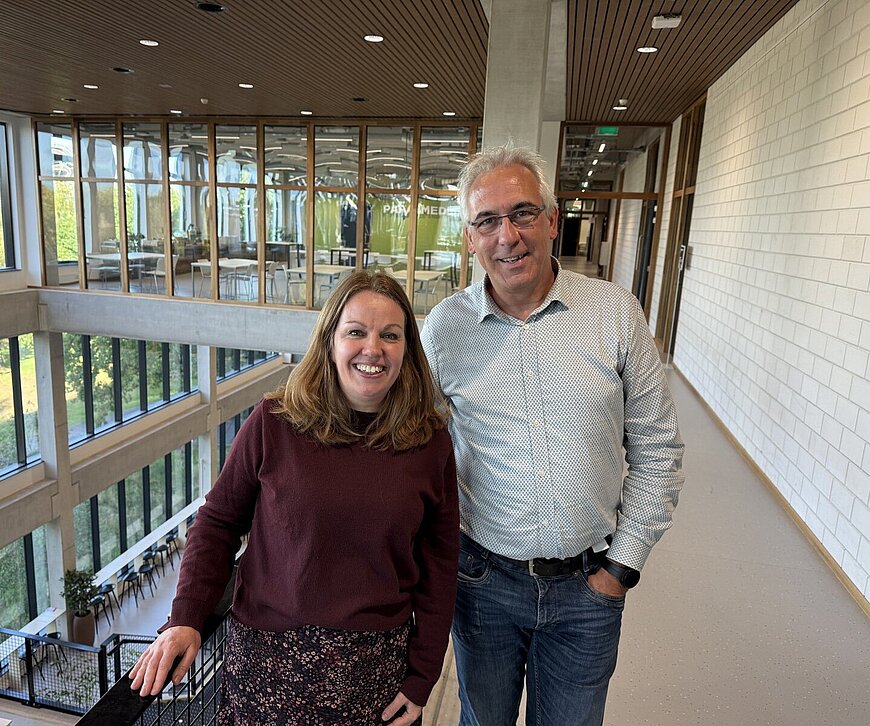
This training programme stems from the partnership formed through Brainport Academy. Fontys, employers, educational institutions and labour market partners pool their knowledge and networks within this initiative. The aim? To help people find a place in the semiconductor sector or to further their career development. Fontys staff members Anne de Bonth and Mark Herman explain more about Fontys’ role within this partnership.
Challenge
First of all: the challenge facing the Brainport region. Over the next ten years, an additional 70,000 technicians and IT professionals are expected to be needed here. To meet this demand, more is needed than just new graduates from the education system. Retraining, further training and the continuous development of talent also play an important role. The partners within the Brainport Academy are therefore working together on a single shared objective: to ensure that enough people can work in, and continue to grow within, the semiconductor sector.
Partnership
Fontys has a role to play in the retraining and further training of professionals. Within the partnership, Fontys represents higher professional education (HBO). Vocational education (MBO) and university education (WO) are also members. The starting point? ‘Partnership’, says Mark Herman. He is an account manager at Fontys and, within the Brainport Academy, project leader for demand analysis and account management. ‘We don’t want the partner organisations to treat each other as client and supplier, but to genuinely engage in dialogue. What is needed today? And tomorrow, and the day after?’
At Fontys, therefore, we do not base our work on the existing range of courses, but on the needs of businesses. These do not necessarily have to be major issues that immediately affect the entire curriculum of degree programmes. ‘The knowledge that students or course participants acquire over four years can also be broken down into smaller chunks. For example, into a course lasting several days.’
Each other’s eyes and ears
To gain a clear understanding of the issues facing businesses, Mark visits companies alongside colleagues from affiliated Brainport Academy partners. ‘This way, we avoid going round in a never-ending loop to the same companies, giving the same old spiel every time.
Working together is far more efficient.’ It’s no coincidence that the partners always conduct these discussions in pairs, preferably from two different organisations. ‘That way, we learn from one another. And sometimes I hear a question and think: that doesn’t really suit Fontys, but it does suit vocational education. For example, when a company needs five extra production staff. Then I ring Summa. We’re not each other’s competitors, but each other’s eyes and ears.’
The companies also recognise the added value of this collaboration. ‘They need to have a full pallet ready by Friday to be invoiced on Monday. But they also know that looking further ahead is important for the long-term viability of their business.’
Transfer
The Manufacturing Excellence Course is one such example of companies and the education sector finding common ground. ‘The course is challenge-based,’ explains Anne de Bonth. She is the programme manager for Lifelong Development (LLO) at Fontys. ‘We start with a kick-off session, after which professionals attend the course in two blocks of four days each.’ This schedule has proved to work well. ‘Previously, the programme was more spread out, but that proved inconvenient for companies. That’s why we’ve reorganised it: participants now have a whole day set aside in their timetable to spend the entire day at Fontys. That’s more efficient than having that professional finish work two hours early every Tuesday afternoon just to attend the course.’
The participants come from different companies. And that is precisely what makes it so valuable. ‘As an educational institution, we have an independent role and can connect companies with one another in a neutral way,’ explains Anne. Once contact has been established, collaboration often arises naturally. And that is exactly what is needed right now within the semiconductor industry. ‘Companies have often optimised their own processes, but the challenge lies in transferring knowledge and products from one company to another. Through the course, we’re experimenting with this on a smaller scale,’ says Anne.
Collaboration as the key
Now that the Brainport Academy is up and running, Anne and Mark are already daring to look further into the future. ‘We know that the affiliated partners recognise the added value of the partnership. But how do we motivate everyone from all these different organisations to continue contributing?’ And by that, Anne doesn’t just mean through the partnership, but as part of everyone’s working methods and processes. ‘We need to be inspired by the impact. And keep a close eye on how we can still be doing what we’re doing now in five years’ time. Or, in fact, even better,’ adds Mark. That demands something from all partners, including Fontys. ‘A partner is not just someone who does everything exactly as you want them to. It means being flexible. Listening to one another. And so, sometimes, stepping out of your comfort zone. But that’s how we’ll make progress.’
Would you like to find out more about how Fontys is contributing to the ‘Talent for Semicon’ initiative?
If so, visit this website or have a look around the Brainport Academy website.
Do you have any questions for Anne and Mark? They’d be happy to help. You can email them at a.debonth@fontys.nl and m.herman@fontys.nl.