First-year student Abdi has found his niche in the cleanroom: ‘Now I know which direction I want to go in’
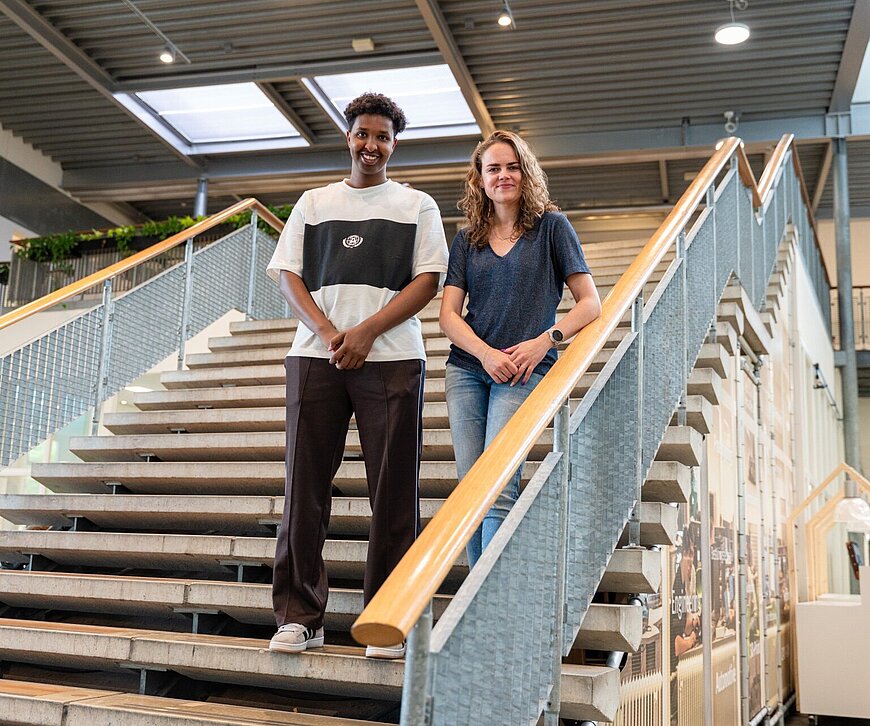
Through an orientation programme, Ter AA enables first-year students with an NT2 background to experience the world of engineering and ICT. This allows students to discover the range of courses and opportunities available. For Abdi Siyaad, a whole new world opened up. ‘For a long time, I didn’t know which direction I wanted to take. Now I do: I can definitely see myself working in a cleanroom.’
Just like Abdi, who is originally from Somalia, some of the first-year students (MBO level 1) come from different cultural backgrounds. ‘They’ve often only been living in the Netherlands for a few years,’ explains teacher Britt de Greef. ‘They’re young men and women who are keen to learn, are meticulous and work hard. They’re building a future here. And technology plays a major role here in the Brainport region in particular. That’s why we think it’s important for them to discover what opportunities are out there.’ Nevertheless, Britt and her colleagues have noticed that students often opt for the familiar path. ‘They say, for example: “My dad’s a carpenter, so that’s what I’ll be too.” And many girls want to go into the care sector. We want to show them that there are more possibilities.’
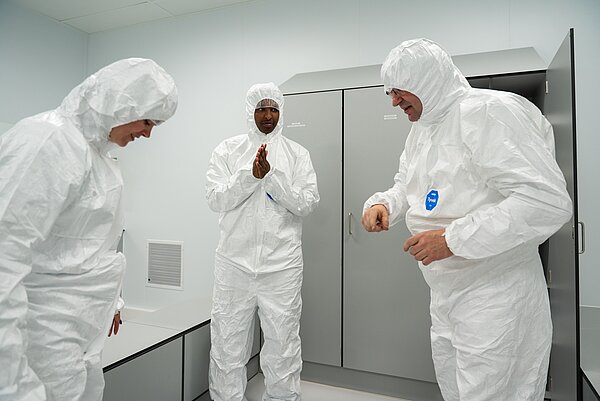
A future in a cleanroom
Through a special induction programme, funded by the Beethoven scheme, students are discovering the world of ICT and engineering. Among other things, they practise programming, welding, soldering and working with robots, and they visit the Techniekcentrum|Brainport. They also step inside Ter AA’s cleanroom, which the company has had for several months now. For Abdi, it was precisely that world that stood out. ‘The teacher showed us how important it is for components to be clean, and therefore how important this work is. I enjoy learning new things, I like a quiet environment and I enjoy working independently. I think this field suits me.’ According to Abdi, he wouldn’t have come to that conclusion without the orientation programme. ‘I now know that there are plenty of good jobs in engineering. And that the sector is much broader than I thought.’
Self-confidence grows
Britt has noticed that more students are coming to the same conclusion. ‘They’re discovering that technology is everywhere. During the programme, they also talk to students on our technical vocational courses. These students explain what the course involves and what opportunities it opens up.’ According to Britt, this, combined with getting stuck in themselves, helps first-year students to grow. ‘They get to know themselves better. What suits me? And how do I see my future? Once you have a clearer idea of that, your self-confidence grows.’ Some of the first-year students do eventually opt for a non-technical course at the end of the programme. ‘And that’s perfectly fine too. Some still enjoy the fact that they’ve had a go at welding, for example. I think it’s particularly important that students look beyond what they already know and have thought carefully about their choice of degree.’
Breaking down barriers
The orientation programme is now in its second year. After this, it will be evaluated and may be continued. Britt sees the greatest benefit in the introduction to technology, which can both close and open doors. ‘Some get excited about a cleanroom or programming, whilst others realise that their future lies elsewhere,’ she says. ‘They get to know themselves better and gain a clearer picture of what does and doesn’t suit them. As a result, they’ll make a much more informed choice about their further studies.’
Beethoven Talent Programme
Ter AA’s orientation programme is made possible in part by the Beethoven Talent Programme. This programme forms part of a national initiative to train more technical talent for the future of the Dutch technology and semiconductor sector. Through the programme, students such as Abdi not only gain an insight into engineering, but, above all, the opportunity to discover where their own talents and interests lie.